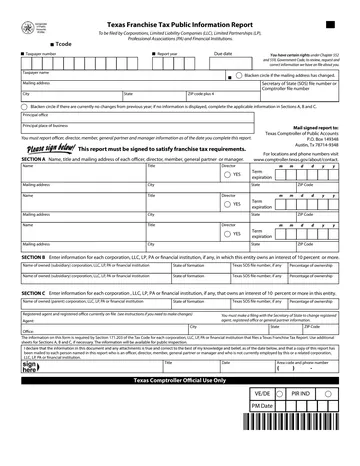
- Who files
- Corporations, LLCs, LPs, PAs and financial institutions
- Due
- May 15, 2026, with or without tax due
- Filed with
- Texas Comptroller (forwarded to the SOS)
- Form revision
- Rev.2-24/35
- Pages
- 1, plus sheets if needed
At a glance
The Texas Franchise Tax Public Information Report, Form 05-102, is a one-page annual report of who runs a Texas taxable entity: its officers, directors, managers and general partners, its 10 percent parent and subsidiary entities, its principal office and its registered agent. The 2026 form is revision Rev.2-24/35. It is filed with the Comptroller, who forwards it to the Secretary of State.
- Who files. “Each taxable entity formed as a corporation, limited liability company (LLC), limited partnership, professional association and financial institution that is organized in Texas or has nexus in Texas must file Form 05-102, Texas Franchise Tax Public Information Report (PIR) annually to satisfy their filing requirements.” Each member of a combined group that is organized in Texas or has nexus in Texas files its own.
- Even with no tax due. “IMPORTANT: The PIR or OIR is due even if the entity does not have to file a franchise tax report because its annualized total revenue is at or below the no tax due threshold.” Since the 2024 report year this report is the only annual filing for most small Texas entities (see the no tax due rules).
- When. With the franchise tax report: May 15, 2026 for the 2026 report year. An entity at or below the threshold that cannot file on time may request an extension with a zero money extension request.
- How. Entities that need only file a Public Information Report or Ownership Information Report can easily file the report electronically through Webfile. Paper reports go to the Texas Comptroller of Public Accounts, P.O. Box 149348, Austin, TX 78714-9348.
- Who does not file. A passive entity is not required to file a Public Information Report, nor is a verified new veteran-owned business during its first five years. A final franchise tax report needs none: A Public Information Report (Form 05-102) or an Ownership Information Report (Form 05-167) is not required to be filed with the final report.
The form, with hotspots
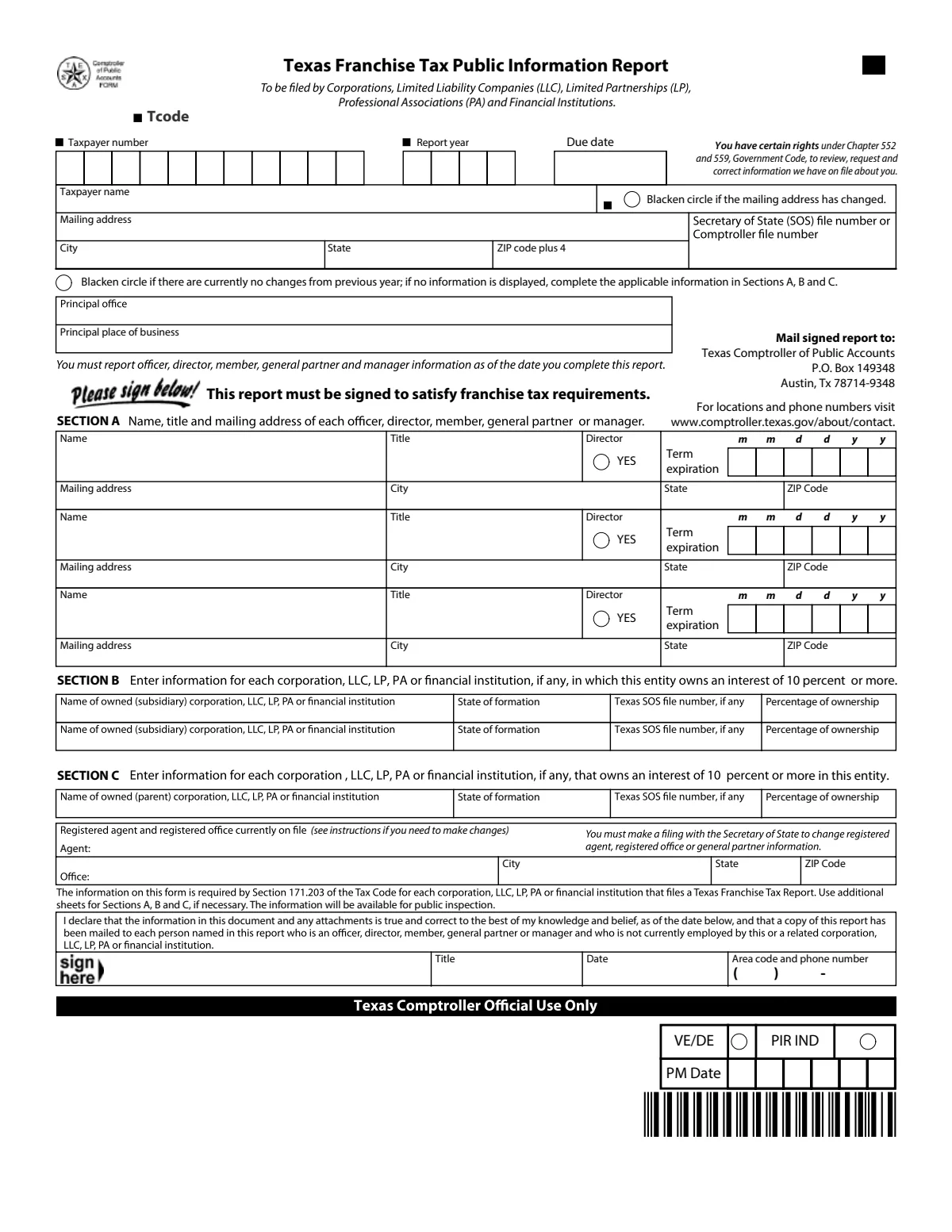
The 2026 Public Information Report from the Comptroller's PDF. Hover or tap a box for the short rule; click it to jump to the full note below. The official use area at the bottom has no hotspots.
Tap a box once for its note, again to jump to the line. Zoom in to read the small print.
Top of the form
The block at the top identifies the entity. If the Comptroller sent a preprinted report, check every preprinted entry against your records before you sign.
| Box | Label | What goes there |
|---|---|---|
| TPN | Taxpayer number | The entity's 11-digit Texas taxpayer number, the same one used on the franchise tax report. |
| Year | Report year; due date | Printed on the 2026 form: 2026 and 5/15/2026. The PIR is due on the date the franchise tax report is due. For an entity at or below the no tax due threshold, that is still May 15. |
| Name | Taxpayer name | The entity's legal name. |
| Addr-chg | Blacken circle if the mailing address has changed | Address changes can be indicated by blackening the circle after the Taxpayer name. |
| Address | Mailing address | The mailing address for the Comptroller's notices. A missed notice is the usual start of a forfeiture. |
| SOS | Secretary of State (SOS) file number or Comptroller file number | The SOS file number for an entity registered with the Secretary of State; otherwise the Comptroller's file number. It ties the report to the SOS record the Comptroller sends it to. |
| City | City, state, ZIP code plus 4 | The rest of the mailing address. |
| No-change | Blacken circle if there are currently no changes from previous year | “If there are no changes to the information in Section A of this report, then blacken the circle as indicated and complete Sections B and C.” If no information is displayed or preprinted on this form, complete all applicable items. |
| Office | Principal office | The address of the principal office. Tax Code 171.203(a)(5) requires both the principal office and the principal place of business. |
| POB | Principal place of business | The address of the principal place of business. |
Section A: officers, directors, members, general partners and managers
Section A is the heart of the report and the part the public sees. List people as of the day you complete the report, not as of the accounting year end. The form says it in italics above Section A: you must report officer, director, member, general partner and manager information as of the date you complete the report.
| Box | Label | What goes there |
|---|---|---|
| A-name | Name | “Report the name, title and mailing address of each officer, director, member, general partner and manager of the corporation, LLC, limited partnership, professional association, or financial institution as of the date the report is filed.” Who must be listed depends on the entity: a Texas for-profit or professional corporation lists all officers, which must include the president and secretary, and all directors (one person may hold every office); Texas non-profit corporations must list all officers. There is a minimum of three directors. Texas limited liability companies must list all managers and, if the company is member-managed, list all members. Limited partnerships must include all general partners. Professional associations report their executive committee members, and non-Texas entities list the officers, directors, members and managers their home state or country requires. |
| A-title | Title | The person's office or role: president, secretary, treasurer, director, manager, managing member, general partner. |
| A-director | Director YES | Blacken YES when the person is a director, so the record shows officers and directors apart. |
| A-term | Term expiration (mm dd yy) | The expiration date of the person's term as an officer or director, if any (Tex. Tax Code 171.203(a)(3)(A)). Leave it blank when there is no fixed term. |
| A-address | Mailing address; city; state; ZIP code | The person's mailing address. Section A is public: the form says the information will be available for public inspection, and the Comptroller shows officer and director information in its online Taxable Entity Search. |
| A-more | Second and third blocks | The same boxes for the next people. The form says to use additional sheets for Sections A, B and C, if necessary, so list every required person even when there are more than three. |
Sections B and C, the registered agent and the signature
Sections B and C map the entity's corporate family at the 10 percent level: subsidiaries below it, parents above it. Both count entities only. “The information will be available for public inspection.”
| Box | Label | What goes there |
|---|---|---|
| B | Section B: owned (subsidiary) corporation, LLC, LP, PA or financial institution; state of formation; Texas SOS file number, if any; percentage of ownership | Each corporation, LLC, limited partnership, professional association or financial institution in which the filing entity owns an interest of 10 percent or more, with the percentage owned (Tex. Tax Code 171.203(a)(1)). Two rows are printed; attach a sheet for more. Leave it blank if there are none. |
| C | Section C: owning (parent) corporation, LLC, LP, PA or financial institution; state of formation; Texas SOS file number, if any; percentage of ownership | Each corporation, LLC, limited partnership, professional association or financial institution that owns 10 percent or more of the filing entity (Tex. Tax Code 171.203(a)(2)). Individuals who own the entity are not listed here; Section C is for entity owners. |
| RA | Registered agent and registered office currently on file | The agent and office the Secretary of State has on file. “Changes to the registered agent or registered office must be filed directly with the Secretary of State, and cannot be made on this form.” The form says the same in its own box: you must make a filing with the Secretary of State to change the registered agent, registered office or general partner information. See registered agent rules. |
| Sign | I declare ... sign here; title; date; area code and phone number | “This report must be signed to satisfy franchise tax requirements.” The signer is an officer, director or other authorized person, which includes a paid preparer authorized to sign the report. By signing, the person also certifies that “a copy of the report has been mailed to each person identified in this subsection on the date the return is filed”: every person listed in Section A who is not currently employed by the entity or a related entity (Tex. Tax Code 171.203(d)). A PIR filed electronically meets the signature rule (171.203(f)). |
PIR or OIR?
Which information report an entity files depends on how it is legally formed, not on how it is taxed federally. A single member LLC that is disregarded for federal tax purposes still files a PIR, because it is an LLC.
Texas Comptroller, PIR and OIR filing requirements; Form 05-915 (2026), Passive Entities and New Veteran-Owned Businesses.
The franchise tax report asks the same question on page 1 (Is this entity a corporation, limited liability company, professional association, limited partnership or financial institution?). A Yes there means a PIR; a No means an OIR, Form 05-167. The PIR and OIR guide compares the two in full.
After you file: the public record and later changes
- It goes to the Secretary of State. PIRs are forwarded to the SOS for processing. Officer and director information on the Comptroller's website comes from the most recent PIRs the SOS processed and shows in the online Taxable Entity Search.
- Changes wait for next year. Changes to information that occur after the report is filed should be reported to the Comptroller on the next PIR the entity is required to file; the Comptroller does not take mid-year updates except for the two cases below.
- Someone listed by mistake. A person named on the report who was not an officer, director, member, general partner or manager on the filing date may file a sworn statement saying so with the Comptroller (Tex. Tax Code 171.203(e)).
- An error on the report. The entity may file an amended PIR with a cover letter explaining the error. The Comptroller's PIR page adds that the amended report goes to P.O. Box 149348 with Amended at the top, and that time-sensitive requests should be marked urgent and faxed to 512-475-0433.
- Getting a copy. If the information is not online, the most recent PIR can be requested from the Comptroller's Open Records Section, P.O. Box 13528, Austin, TX 78711-3528.
Rules that trip filers up
- Unsigned is unfiled. “Even if the franchise tax report is filed and all taxes paid, the right to transact business may be forfeited for failure to file the completed and signed PIR.” Forfeiture denies the entity the right to sue or defend in a Texas court and makes each officer and director personally liable for certain debts (Tex. Tax Code 171.251, 171.252 and 171.255). Forfeiture does not apply to financial institutions.
- No tax due still means a PIR. Since 2024 there is no No Tax Due Report: the Comptroller discontinued the No Tax Due Report for the 2024 report year and later. The PIR is what keeps a small entity current.
- Agent changes go to the SOS. Writing a new registered agent on the PIR changes nothing at the Secretary of State. File the SOS change form; a stale agent can lead to an involuntary termination for a separate, non-tax reason.
- One PIR per entity. A combined group files one franchise tax report but a separate PIR for each corporation, LLC, LP, PA or financial institution in the group that is organized in Texas or has nexus in Texas.
- Mail the copies. The signature certifies that a copy went to each listed person not employed by the entity or a related entity. Keep a record of those mailings.
How it connects
- The full comparison and the filing rules: Texas Public Information Report vs Ownership Report.
- Whether the PIR is your only filing: Texas No Tax Due rules; the tax reports it goes with: Form 05-158 and Form 05-169.
- What happens if it is missed: Texas forfeiture and reinstatement, and the tax clearance request, Form 05-391.
- Other states' annual reports: the annual report hub; Texas overall: Texas good standing.
Questions filers ask
Do I have to file a PIR if my LLC owes no franchise tax?
Yes. For the 2026 report year an entity at or below the $2,650,000 no tax due threshold files no franchise tax report, but the LLC still files the Public Information Report by May 15. Missing it can lead to forfeiture of the right to transact business.
Who signs the Public Information Report?
An officer, director or other authorized person, which includes a paid preparer authorized to sign. The report must be signed to satisfy franchise tax requirements.
Is the information on the PIR public?
Yes. The form says the information will be available for public inspection, and officer and director information appears in the Comptroller's online Taxable Entity Search. The Ownership Information Report, by contrast, is confidential.
Can I change my registered agent on the PIR?
No. Changes to the registered agent or registered office must be filed directly with the Secretary of State and cannot be made on the PIR.
An officer resigned in June. Do I file a new PIR?
Not as a rule. The Comptroller takes changes on the next PIR. An entity with an error or a critical need may file an amended PIR with a cover letter, and a person listed in error may file a sworn statement.
Does a disregarded single member LLC file its own PIR?
Yes, if it is organized in Texas or has nexus in Texas. Federal treatment does not decide Texas franchise tax responsibility, and an LLC files the PIR.
Sources
- Texas Franchise Tax Public Information Report, Form 05-102, 2026 (PDF)
- Texas Comptroller, Public Information Report and Ownership Information Report filing requirements
- 2026 Texas Franchise Tax Report Information and Instructions, Form 05-915 (PDF)
- Texas Comptroller, No Tax Due reporting changes from 2024
- Texas Tax Code chapter 171, section 171.203