- Who files
- Entities over $2,650,000 that do not use the E-Z report
- Due
- May 15, 2026
- Filed with
- Texas Comptroller, with the PIR or OIR
- Form revision
- Rev.8-25/11 (2026 report)
- Pages
- 2 (05-158-A and 05-158-B)
At a glance
The Texas Franchise Tax Report, Long Form, is two pages: Form 05-158-A (revenue, cost of goods sold and compensation) and Form 05-158-B (margin, apportionment and tax due). The 2026 forms carry revision Rev.8-25/11 and are for the report due May 15, 2026. Every line note below comes from the 2026 Texas Franchise Tax Report Information and Instructions (Form 05-915, Rev. 4-26/2) and Tax Code chapter 171.
- Who files it. “Any entity (including a combined group) that does not qualify to file using the EZ computation or that does not have $2,650,000 or less in annualized total revenue should file this report.” An entity at $20 million or less of annualized revenue may file the shorter E-Z Computation Report instead, and an entity at or below $2,650,000 files no tax report at all, only its information report (see the no tax due rules).
- When. “An annual report, if required, is due May 15 of each report year.” If the due date (original or extended) of a report falls on a Saturday, Sunday or legal holiday included on the list published before Jan. 1 of each year in the Texas Register, the due date is the next business day.
- What goes with it. The Public Information Report (05-102) or the Ownership Information Report (05-167), plus any schedules: the Affiliate Schedule (05-166) for a combined group, the Credits Summary Schedule (05-181) for credits, the Tiered Partnership Report (05-175) for that election, and the Payment Form (05-170) when you pay by check.
- How. Electronically file and pay your franchise tax report using Webfile. Approved tax preparation software also works, and the paper forms go to the Comptroller's P.O. box. Webfile is not recommended for combined groups with more than 10 members.
Form 05-915 (2026): Due Dates, Extension of Time to File, and Forfeiture.
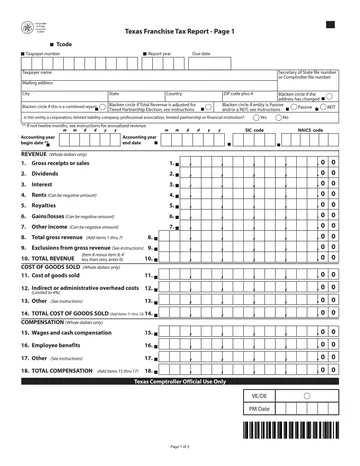
The form, with hotspots
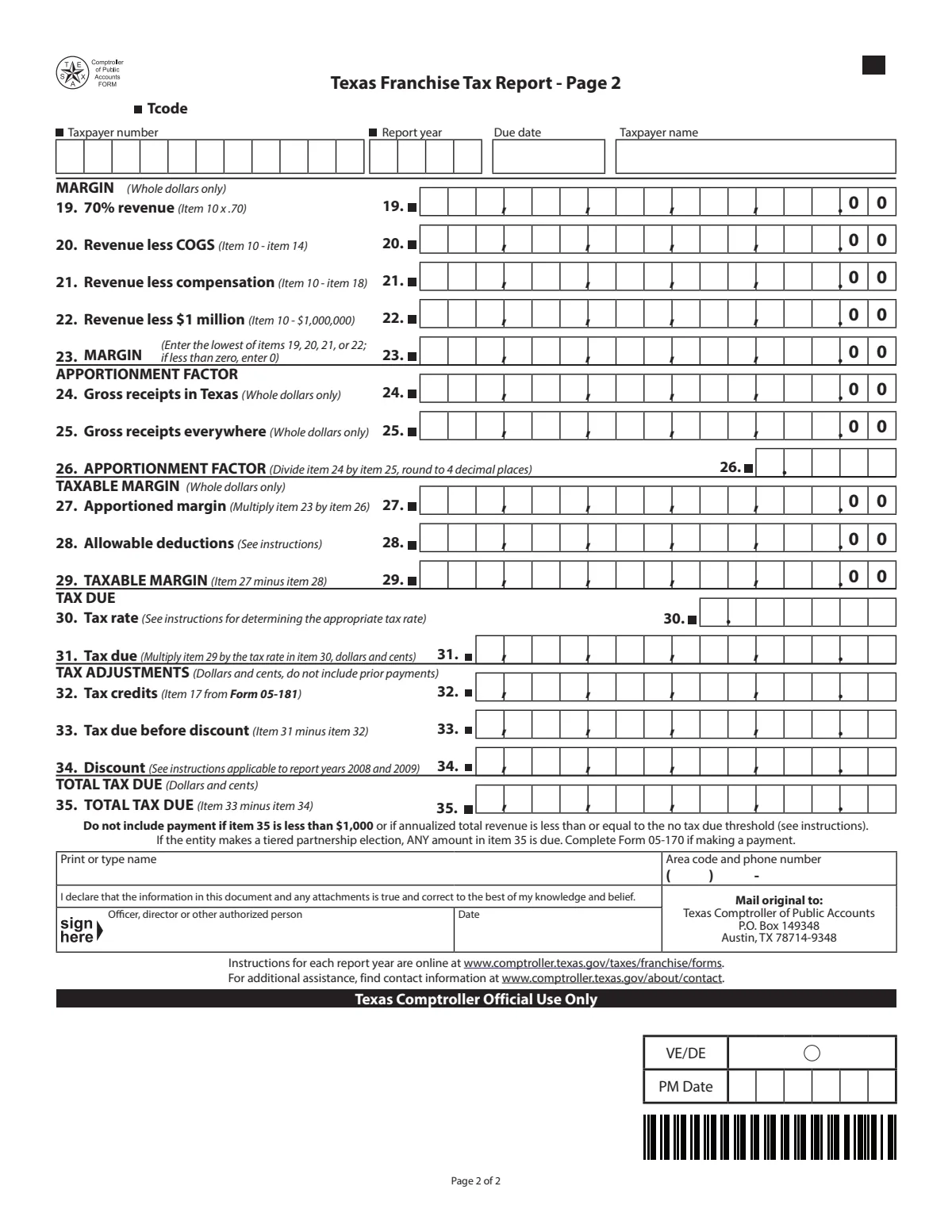
Both pages of the 2026 Long Form, from the Comptroller's PDF. Hover or tap a box for the short rule, then click it to jump to the full note in the tables below. The Comptroller's official use boxes at the bottom of each page have no hotspots: filers leave them blank.
Tap a box once for its note, again to jump to the line. Zoom in to read the small print.
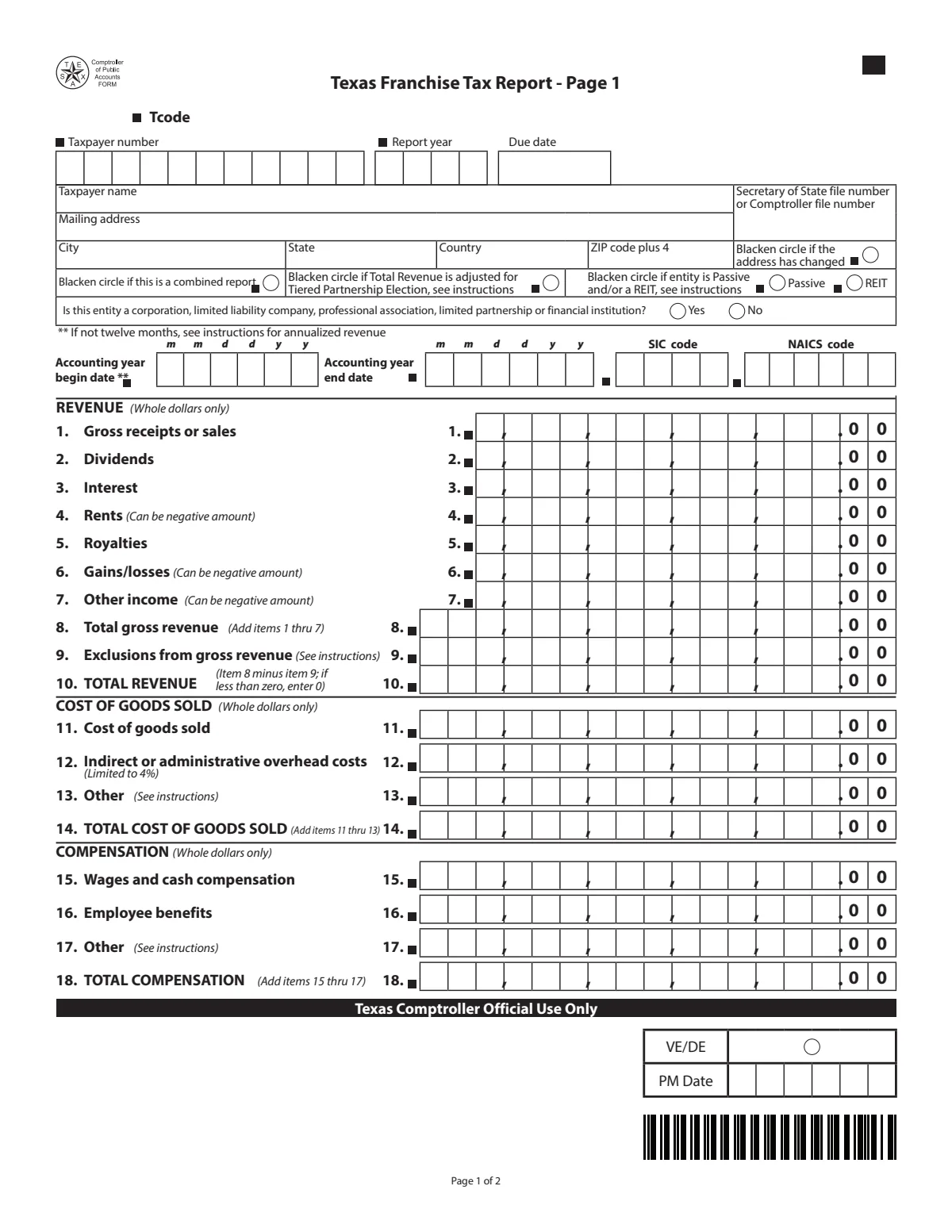
Top of page 1: taxpayer information
The block at the top identifies the entity and the period. Two entries change the tax itself: the accounting year dates, which set the period whose revenue is reported, and the SIC code, which sets the rate. A passive entity or qualifying REIT completes this block only.
| Line | Label | What goes there |
|---|---|---|
| TPN | Taxpayer number | Enter the Texas taxpayer number that has been assigned to your entity by the Comptroller’s office. If you do not have an assigned number, enter your federal employer identification number (FEIN). The taxpayer number has 11 digits; it is also what you need, with the 6-digit XT Webfile number on the franchise tax notice, to file on Webfile. |
| Year | Report year; due date | The report year is the year the report is due: 2026 for this report. For annual filers, enter May 15, 2026. A final report uses the due date on the letter the Comptroller sent. |
| Name | Taxpayer name | The legal name of the entity filing the report. For a combined report, the reporting entity's name. |
| SOS | Secretary of State file number or Comptroller file number | The number assigned to the entity by the SOS or Comptroller. Entities registered with the Secretary of State have an SOS file number, assigned when the entity was formed or registered. |
| Address | Mailing address | The mailing address of the entity filing the report. Notices, including the notice of intent to forfeit, are sent to the address on file, so a stale address is how many entities lose their right to transact business without knowing it. |
| City | City, state, country, ZIP code plus 4 | The rest of the mailing address. |
| Addr-chg | Blacken circle if the address has changed | If there is a change of address for this entity, blacken the circle. This changes the mailing address only. Changes to the registered agent or registered office are filed with the Secretary of State. |
| Combined | Blacken circle if this is a combined report | If this report is being filed on behalf of an affiliated group of entities engaged in a unitary business, blacken the circle. Combined reporting is mandatory for an affiliated group (more than 50% common ownership) in a unitary business. The reporting entity files one report for the group and lists every member on the Affiliate Schedule, Form 05-166. |
| Tiered | Blacken circle if Total Revenue is adjusted for Tiered Partnership Election | For an upper tier entity reporting revenue passed to it, or a lower tier entity excluding revenue it passed up. Complete Form 05-175 as well. “Do not blacken this circle just because you own an interest in another entity.” |
| Passive | Blacken circle if entity is Passive and/or a REIT | A partnership or trust that qualifies as a passive entity (at least 90% of federal gross income from dividends, interest, capital gains, mineral royalties and similar sources), or a qualifying REIT, should blacken the appropriate circle and complete the “Taxpayer Information” part of this form only. A passive entity does not file a PIR or OIR; a qualifying REIT still does. |
| Entity-type | Is this entity a corporation, limited liability company, professional association, limited partnership or financial institution? | Answer Yes or No. These are the entity types that file the Public Information Report (Form 05-102); other taxable entities, such as general partnerships, trusts and associations, file the Ownership Information Report (Form 05-167). |
| Begin | Accounting year begin date | Enter the day after the end date on the previous franchise tax report. If the 2025 report ended 12-31-2024, the 2026 report begins 01-01-2025. An entity that was at or below the no tax due threshold last year and filed no tax report still uses the day after the end date it would have used. For entities that became subject to the tax in 2025, enter the date the entity became subject to the tax. |
| End | Accounting year end date | Enter the last accounting period end date for federal income tax purposes in the year before the year the report is originally due. A change in the federal tax year does not create a short Texas report; the period can run more or less than 12 months. |
| SIC | SIC code | “This field determines the tax rate.” “Completion of the field is optional; however, if left blank, the tax rate defaults to 0.75%.” A qualifying retailer or wholesaler enters its 1987 SIC retail or wholesale code to use 0.375% (item 30); other entities enter the code for the majority of their revenue. |
| NAICS | NAICS code | Enter the code that is appropriate for the taxable entity or the code that reflects the overall business activity of a combined group. |
Items 1 to 10: total revenue
Total revenue starts from fixed lines of the entity's federal income tax return, which is why the instructions list a line for each federal form. Total revenue is based on amounts correctly reported on specific lines from the entity’s corresponding federal tax return. An entity that was part of a federal consolidated return, or disregarded federally, reports as if it had filed its own federal return, unless it is treated as disregarded in a combined group. All amounts on page 1 are in whole dollars.
| Line | Label | What goes there |
|---|---|---|
| 1 | Gross receipts or sales | From the entity's federal return: Form 1120 line 1c (corporation), Form 1120S line 1c (S corporation), Form 1065 line 1c (partnership), Form 1040 Schedule C line 3 (a single member LLC filing as a sole proprietorship; the instructions cite the same line for a trust). Any other federal form: a substantially equivalent amount. The line numbers are the instructions' own: The line items indicated in this section refer to specific lines from the 2024 Internal Revenue Service (IRS) forms. |
| 2 | Dividends | Form 1120 line 4; Form 1120S Schedule K line 5a; Form 1065 Schedule K line 6a; Form 1041 line 2a; for a single member LLC, the dividend part of Schedule C line 6. |
| 3 | Interest | Form 1120 line 5; Form 1120S Schedule K line 4; Form 1065 Schedule K line 5; Form 1041 line 1. The amount reported must be zero or greater. |
| 4 | Rents (can be negative) | Form 1120 line 6; Form 1120S Schedule K line 3a plus Form 8825 lines 18a and 19; Form 1065 Schedule K line 3a plus Form 8825 line 18a; Schedule E line 23a for a trust or a single member LLC. Do not include in Item 4 net rental income (loss) passed through from a partnership or S corporation on IRS Form K-1; report this amount in Item 7. |
| 5 | Royalties | Form 1120 line 7; Form 1120S Schedule K line 6; Form 1065 Schedule K line 7; Schedule E line 23b for a trust or a single member LLC. |
| 6 | Gains/losses (can be negative) | Form 1120 lines 8 and 9; Form 1120S line 4 and Schedule K lines 7, 8a and 9; Form 1065 line 6 and Schedule K lines 8, 9a and 10; Form 1041 line 7; for a single member LLC, Schedule D and Form 4797 line 17 to the extent they relate to the LLC. |
| 7 | Other income (can be negative) | Other income from the return to the extent not already included (Form 1120 line 10; Form 1120S line 5 and Schedule K; Form 1065 lines 4 and 7 and Schedule K line 11; Schedule F), plus any total revenue passed to you by a lower tier entity under the tiered partnership election. |
| 8 | Total gross revenue | Items 1 through 7 added together. |
| 9 | Exclusions from gross revenue | “Only the following items may be excluded from gross revenue.” The common ones: bad debt expense; foreign dividends and royalties; the entity's share of net distributive income from another taxable entity treated as a partnership or S corporation; the Schedule C dividends received deduction; flow-through funds required by law, fiduciary duty or contract (sales commissions to non-employees, payments to subcontractors for work on real property); dividends and interest from federal obligations. Industry exclusions follow (lending institutions, professional employer organizations, health care providers, management companies, couriers, legal services and others). A combined group subtracts intercompany revenue here, and a lower tier entity subtracts revenue passed up under a tiered election. |
| 10 | Total revenue | Item 8 minus Item 9. If less than zero, enter zero. Then the threshold test: “If the annualized total revenue is less than or equal to $2,650,000, and the entity is not an upper or lower tier entity making the tiered partnership election, stop here, you are not required to file a franchise tax report.” The PIR or OIR is still due. At $20 million or less annualized, the entity may switch to the E-Z Computation Report. |
Items 11 to 14: cost of goods sold
Fill in items 11 to 14 only if the entity has qualifying COGS. If it does not, leave them blank and the margin will come from one of the other three methods. A taxable entity subject to Internal Revenue Code 263A, 460 or 471 may expense or capitalize its allowable costs; the choice is made by filing the report one way or the other and cannot be changed after the due date or the filing date, whichever is later.
| Line | Label | What goes there |
|---|---|---|
| 11 | Cost of goods sold | A taxable entity has eligible COGS ONLY if the taxable entity sells real or tangible personal property in the ordinary course of business or fits an exception in Tax Code 171.1012 or Rule 3.588. A service business generally has none; where a sale mixes goods and services, only the cost tied to the goods counts. COGS includes direct labor, materials, handling, storage, production depreciation, production equipment rent and repairs, and related research costs. It excludes selling, distribution and advertising costs, interest, income taxes and officers' compensation. “It is a calculated amount specific to Texas franchise tax.” New for 2026: a one-time net depreciation adjustment for qualifying production assets placed in service before the 2026 report's begin date. |
| 12 | Indirect or administrative overhead costs (limited to 4%) | Mixed service costs such as security, legal, data processing, accounting and personnel costs that you can show are allocable to acquiring or producing the goods. This amount is limited to 4% of total indirect/administrative overhead costs. |
| 13 | Other (COGS) | Only three things go here, and they offset each other: compensation of undocumented workers (subtract it), wages of a Texas resident on active military duty plus the cost of training a replacement (add), and qualifying aerospace costs under the Federal Acquisition Regulation (add). |
| 14 | Total cost of goods sold | Items 11 through 13 added together. It feeds item 20. |
Items 15 to 18: compensation
Compensation is the other big subtraction. The $480,000 per person limit applies to 2026 and 2027 reports. A client of a professional employer organization may count the wages and benefits it paid for its covered employees, but not the organization's administrative fee or payroll taxes.
| Line | Label | What goes there |
|---|---|---|
| 15 | Wages and cash compensation | Medicare wages and tips on Form W-2, net distributive income reported to natural persons from partnerships, LLCs and S corporations (negative amounts included), and stock awards and options deducted federally, “limited to $480,000 per person per 12-month period, prorated for the period upon which the tax is based”. It does not include payments on Forms 1099, amounts excluded from revenue, or the employer's share of employment taxes. |
| 16 | Employee benefits | Workers' compensation, health care and retirement benefits for officers, directors, owners, partners and employees. “The deduction for employee benefits is not limited to $480,000 per person but is only deductible to the extent deductible for federal income tax purposes.” |
| 17 | Other (compensation) | The same three items as item 13, for compensation: subtract undocumented worker wages, add active duty pay and training of a replacement, add qualifying aerospace costs not already subtracted. |
| 18 | Total compensation | Items 15 through 17 added together. It feeds item 21. |
Items 19 to 23: margin (page 2)
Page 2 begins by computing the four margins side by side. Most entities do not know which method wins until they see the four numbers, which is why the form asks for all of them.
Items 1 to 35 of Forms 05-158-A and 05-158-B; 2026 Texas Franchise Tax Report Information and Instructions (Form 05-915). The 0.375% rate is denied if the SIC code does not support it.
| Line | Label | What goes there |
|---|---|---|
| P2-header | Taxpayer number; report year; due date; taxpayer name (page 2) | Repeat the taxpayer number and name from page 1. The 2026 form prints the report year and the 05/15/2026 due date. Page 2 is filed with page 1 every time, including on an amended report, which must include all pages. |
| 19 | 70% revenue (item 10 x .70) | Item 10 times 70%. |
| 20 | Revenue less COGS (item 10 minus item 14) | If less than zero, enter zero. |
| 21 | Revenue less compensation (item 10 minus item 18) | If less than zero, enter zero. |
| 22 | Revenue less $1 million (item 10 minus $1,000,000) | If less than zero, enter zero. A combined group gets one $1 million for the whole group, not one per member. |
| 23 | Margin | “Enter the lowest amount from Items 19, 20, 21, or 22.” You do not elect a method in advance: entering the lowest figure is the choice. |
Items 24 to 26: apportionment
Texas taxes only the Texas share of margin, measured by gross receipts alone. An entity with no Texas receipts still files: The apportionment factor of an entity with zero Texas gross receipts is zero; therefore, no tax is due.
| Line | Label | What goes there |
|---|---|---|
| 24 | Gross receipts in Texas | For the same period as total revenue. Texas receipts include sales of tangible personal property when the property is delivered or shipped to a purchaser within Texas; receipts from services performed within Texas; rentals of Texas property; royalties and license fees for use in Texas; software, intangibles and securities when the payor is legally domiciled in Texas; and the net gain (not a net loss) from a Texas-sourced sale of a capital asset or investment. |
| 25 | Gross receipts everywhere | All sales, rentals, services, royalties, dividends and interest and other business receipts, plus net gains on capital assets and investments. Any item of revenue excluded from total revenue (Item 10) must not be included in computing gross receipts everywhere. |
| 26 | Apportionment factor | If Texas gross receipts in Item 24 are zero, enter zero. If item 24 equals or exceeds item 25, enter 1.0000. Otherwise divide item 24 by item 25 and round to 4 places. An entity with zero Texas receipts owes no tax but still files the report. |
Items 27 to 35: taxable margin and tax due
Items 31 to 35 are in dollars and cents; the lines above them are whole dollars. The Texas franchise tax calculator runs the same steps and compares the result with the E-Z computation.
| Line | Label | What goes there |
|---|---|---|
| 27 | Apportioned margin | Item 23 times item 26. |
| 28 | Allowable deductions | Only three: 10% of the amortized cost of a qualifying solar energy device, 10% of the amortized cost of qualifying clean coal project equipment, and the cost of relocating the main office or principal place of business to Texas (on the first annual report). None may reduce apportioned margin below zero, and none carries over. |
| 29 | Taxable margin | Item 27 minus item 28. |
| 30 | Tax rate | 0.0075 (0.75%) for most entities; 0.00375 (0.375%) for qualifying wholesalers and retailers (Tex. Tax Code 171.002). “If the SIC code on Form 05-158-A does not fit the definition of qualifying retailers and wholesalers on page 4, the 0.375% tax rate will be denied when the report is processed.” |
| 31 | Tax due | Item 29 times item 30, in dollars and cents. |
| 32 | Tax credits | The allowable credits from the Credits Summary Schedule. Form 05-181 (Texas Franchise Tax Credits Summary Schedule) is replacing Form 05-160 as the summary schedule for claiming credits against the franchise tax. Credits include the Subchapter T research credit (Form 05-182), the historic structure credit and the housing development credit. |
| 33 | Tax due before discount | Item 31 minus item 32. If less than zero, enter zero. |
| 34 | Discount | Discounts do not apply to reports due after Dec. 31, 2009. Leave it at zero. |
| 35 | Total tax due | Item 33. “If this amount is less than $1,000, you owe no tax, but you must submit this report along with the Public Information Report (Form 05-102) and/or the Ownership Information Report (Form 05-167).” The form prints the exception: If the entity makes a tiered partnership election, ANY amount in item 35 is due. Pay on Webfile (credit card or electronic check), by TEXNET, or by check payable to the Texas Comptroller with the Payment Form, 05-170. |
Signature and mailing
Send both pages, all schedules, the PIR or OIR and, if paying by check, the Payment Form and the payment.
| Line | Label | What goes there |
|---|---|---|
| Signer | Print or type name; area code and phone number | The name of the person who signs, and a daytime phone number. |
| Sign | Officer, director or other authorized person; date | Report may be signed by an officer, director or other authorized person. This includes a paid preparer authorized to sign the report. The signer declares that the information is true and correct to the best of their knowledge and belief. |
| Mail original to | Texas Comptroller of Public Accounts, P.O. Box 149348, Austin, TX 78714-9348. A designated private delivery service goes to 111 E. 17th St., Austin, TX 78701-1334, which keeps the timely mailing rule. |
Rules that trip filers up
- Annualize for the tests, not for the tax. “To annualize total revenue, divide total revenue by the number of days in the period upon which the report is based, and multiply the result by 365.” The Comptroller's own example: $800,000 of revenue over 108 days annualizes to $2,703,703.70, which is over the $2,650,000 threshold, so a report is due, but the entity still reports $800,000 on item 10.
- No tax is not the same as no report. There is no minimum tax requirement under the franchise tax provisions. An entity above the threshold whose tax works out under $1,000 pays nothing but files the Long Form or E-Z report and its PIR or OIR. Missing reports lead to forfeiture even when nothing is owed.
- No estimated payments. Texas law does not require the filing of estimated tax reports or payments.
- Extensions take money. A non-EFT payor extends to Nov. 16, 2026 by requesting on Webfile or Form 05-164 by May 15 and paying at least 90% of this year's tax or 100% of last year's (if last year's report was filed by May 14, 2026). Entities that must pay by EFT (those that paid $10,000 or more in franchise tax in the prior state fiscal year) extend to Aug. 17, 2026 first.
- Penalties. “Taxpayers are assessed a $50 penalty when a franchise tax report is filed late.” Late payment adds 5% of the tax, and another 5% after 30 days. Delinquent taxes accrue interest beginning 60 days after the date the tax is due.
- Amending. If an entity needs to amend a report, it must file all pages of the amended report along with a cover letter explaining the reason for the amendment. Write AMENDED at the top. A refund claim must state each reason it rests on.
- Forfeiture. Reports or payments still missing 45 days after the Notice of Intent to Forfeit can cost the entity its right to transact business, and its officers and directors become personally liable for debts incurred meanwhile (Tex. Tax Code 171.251 and 171.255). See Texas forfeiture and reinstatement.
How it connects
- The rules behind the lines: Texas franchise tax: rates, margin and the 2026 threshold, and the franchise tax in every state.
- Whether you need this form at all: the Texas No Tax Due rules from 2024.
- The shorter alternative: Form 05-169, E-Z Computation Report. The information report that goes with it: Form 05-102 or Form 05-167.
- The numbers: the Texas franchise tax calculator.
- Everything Texas: Texas good standing, including the split between the Comptroller's tax status and the Secretary of State's record.
Questions filers ask
Do I file Form 05-158 if my revenue is under the threshold?
No. For the 2026 report, an entity whose annualized total revenue is $2,650,000 or less (and that makes no tiered partnership election) files no franchise tax report. It still files the Public Information Report or Ownership Information Report by May 15.
Can I pick the COGS method even if compensation gives a lower margin?
Item 23 takes the lowest of items 19 to 22, so the lowest margin wins. The form does not ask you to elect a method; you compute all four and enter the lowest. A combined group uses one method for every member.
We are a retailer. How do we get the 0.375% rate?
Enter a 1987 SIC retail or wholesale code on page 1 and 0.00375 on item 30, and meet the statutory test: more revenue from retail or wholesale trade than from other activities, less than 50% from products you or an affiliate produce (eating and drinking places excepted), and no utility sales. If the SIC code does not fit, the Comptroller applies 0.75% when it processes the report.
Our tax came to $640. Do we send anything?
Send the report and the PIR or OIR, but no payment. A computed tax under $1,000 is not due. The exception is the tiered partnership election, where any amount on item 35 is due.
What federal year do I use for the 2026 report?
The accounting year that ended in 2025: the begin date is the day after the end date on your 2025 report, and the end date is your last federal tax year end in 2025. A calendar year entity reports January 1 to December 31, 2025.
Is the Long Form ever cheaper than the E-Z report?
Often. The E-Z rate of 0.331% applies to all apportioned revenue with no subtractions. The Long Form rate of 0.75% applies to margin, so it wins whenever margin is under about 44% of revenue (our arithmetic: 0.331 divided by 0.75). For a qualifying retailer or wholesaler at 0.375%, even the 70% margin works out to 0.2625% of revenue, below the E-Z rate.