- Who files
- Partnerships, trusts, associations and other non-PIR entities
- Due
- May 15, 2026, with or without tax due
- Filed with
- Texas Comptroller
- Form revision
- Rev.2-24/8
- Public?
- No: ownership details are confidential
At a glance
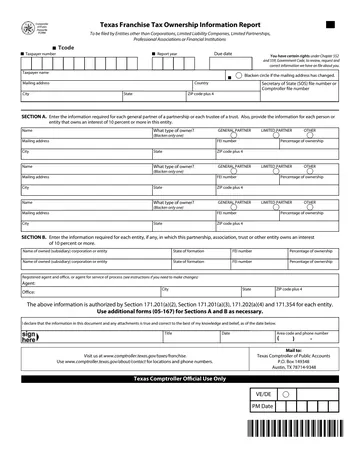
The Texas Franchise Tax Ownership Information Report, Form 05-167, is the annual information report for taxable entities that are not corporations, LLCs, limited partnerships, professional associations or financial institutions: general and limited liability partnerships, trusts, business associations, joint ventures and other legal entities. It reports the general partners and the 10 percent owners. The 2026 form is revision Rev.2-24/8.
- Who files. “Each taxable entity, other than a legally formed corporation, LLC, limited partnership, professional association or financial institution, that is organized in Texas or has nexus in Texas is required to file Form 05-167, Franchise Tax Ownership Information Report (OIR) annually to satisfy their filing requirements.”
- When. With the franchise tax report: May 15, 2026. It is due even when no franchise tax report is due because the entity is at or below the $2,650,000 no tax due threshold.
- Signed by. A partner, member, owner or other authorized person, including a paid preparer authorized to sign.
- Confidential. “Ownership information on OIRs is confidential and is not displayed on the Comptroller’s website.”
- Statutory basis. The form cites its authority: “The above information is authorized by Section 171.201(a)(2), Section 171.201(a)(3), 171.202(a)(4) and 171.354 for each entity.”
The form, with hotspots
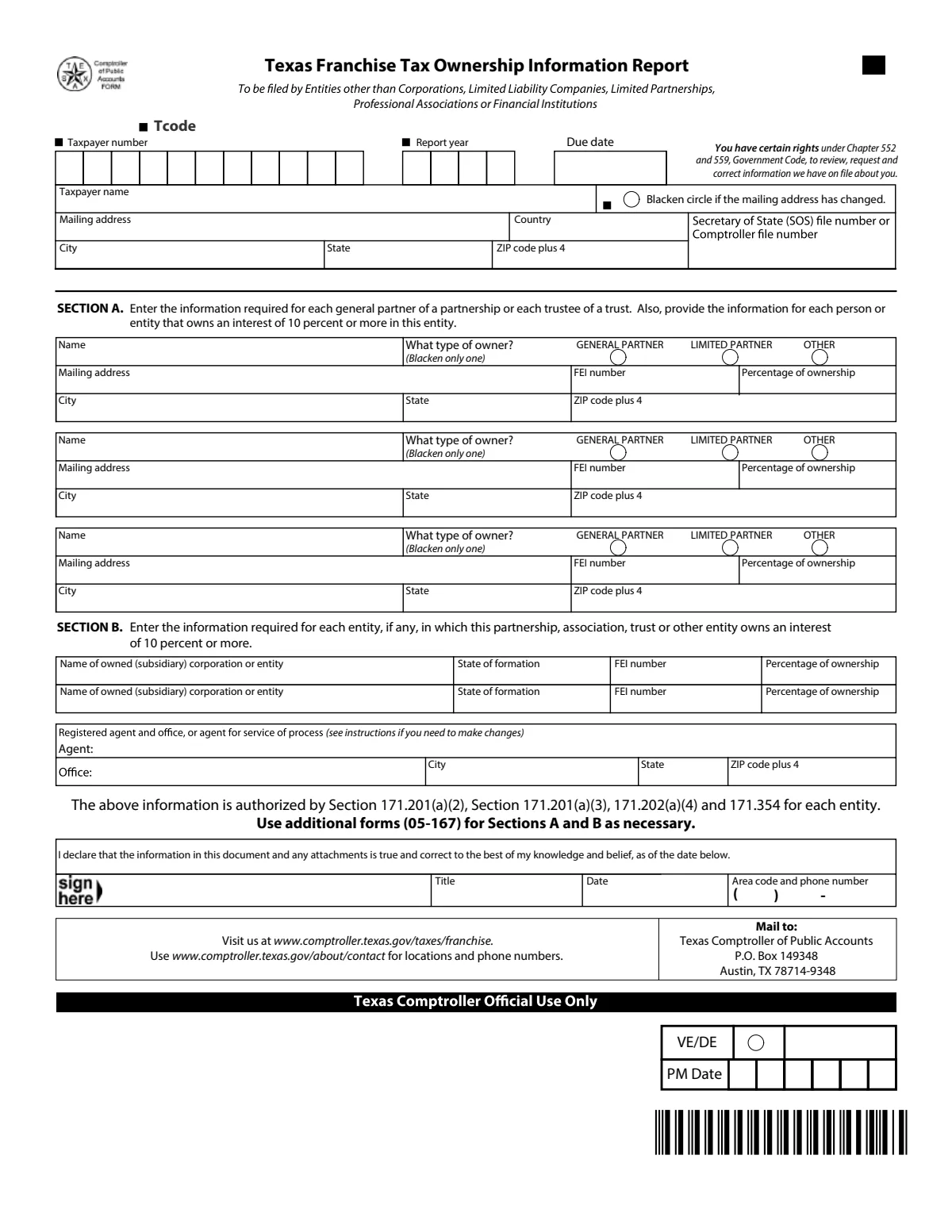
The 2026 Ownership Information Report from the Comptroller's PDF. Hover or tap a box for the short rule; click it to jump to the full note. The official use area at the bottom has no hotspots.
Tap a box once for its note, again to jump to the line. Zoom in to read the small print.
Top of the form
The top block identifies the entity. Unlike the PIR, the OIR has a country box in the address line and no principal office lines.
| Box | Label | What goes there |
|---|---|---|
| TPN | Taxpayer number | The entity's 11-digit Texas taxpayer number. |
| Year | Report year; due date | Printed on the 2026 form: 2026 and 5/15/2026. The OIR is due on the date the franchise tax report is due, whether or not the entity owes tax. |
| Name | Taxpayer name | The entity's legal name. |
| Addr-chg | Blacken circle if the mailing address has changed | Address changes can be indicated by blackening the circle after the Taxpayer Name. |
| Address | Mailing address; country | Where the Comptroller sends notices, with the country. |
| SOS | Secretary of State (SOS) file number or Comptroller file number | The SOS file number if the entity is registered with the Secretary of State (a limited liability partnership, for example); otherwise the Comptroller's file number. |
| City | City, state, ZIP code plus 4 | The rest of the mailing address. |
Section A: general partners, trustees and 10 percent owners
The form's own heading: “Enter the information required for each general partner of a partnership or each trustee of a trust.” Owners are listed as of the date the report is filed.
Form 05-915 (2026), Form 05-167 Section A instructions.
| Box | Label | What goes there |
|---|---|---|
| A-name | Name | “Report the name, title and mailing address of each general partner and each person or entity that owns an interest of 10% or more of the taxable entity as of the date that the report is filed.” A partnership lists every general partner and every 10 percent owner; a trust lists its trustee; an association lists the individuals who have authority to sign a contract on its behalf; any other entity lists its executive board members. |
| A-type | What type of owner? (Blacken only one): general partner, limited partner, other | Trusts should report their trustee information and not check any box (partner or other). An association reports the people with contract authority and also checks no box. All other entities should report their executive board members and check the other box. |
| A-address | Mailing address | The owner's mailing address. |
| A-fei | FEI number | The owner's federal employer identification number, for an owner that has one. If there is no federal employer identification number for the owner(s), leave the field blank. “(Do not enter any Social Security numbers.)” |
| A-pct | Percentage of ownership | The owner's percentage interest. A general partner is listed whatever its percentage; anyone else is listed at 10 percent or more. |
| A-city | City; state; ZIP code plus 4 | The rest of the owner's mailing address. |
| A-more | Second and third blocks | The same boxes for the next owners. “Use additional forms (05-167) for Sections A and B as necessary.” |
Section B, the agent and the signature
Section B lists the entities the filer owns 10 percent or more of. Below it, the agent box names the person who accepts service of process for the entity.
| Box | Label | What goes there |
|---|---|---|
| B | Section B: name of owned (subsidiary) corporation or entity; state of formation; FEI number; percentage of ownership | Each entity, if any, in which the partnership, association, trust or other entity owns an interest of 10 percent or more. Two rows are printed; use more copies of the form for others. |
| RA | Registered agent and office, or agent for service of process | “This should include the entity’s registered agent or agent for service of process in accordance with Texas Tax Code Section 171.354.” That section requires every taxable entity to “designate a resident of this state as the taxable entity's agent for the service of process”. Changes to the registered agent or registered office must be filed directly with the Secretary of State, and cannot be made on this form. |
| Sign | I declare ... sign here; title; date; area code and phone number | The report must be completed and signed by a partner, member, owner, or other authorized person. A paid preparer authorized to sign may sign. The signer declares that the information is true and correct as of the date written. |
| Mail to | Texas Comptroller of Public Accounts, P.O. Box 149348, Austin, TX 78714-9348. The OIR can also be filed on Webfile. |
Who files the OIR, and who files neither report
The OIR is for taxable entities outside the five PIR types. The franchise tax reaches partnerships (general, limited and limited liability), certain trusts, business associations, joint ventures and other legal entities; limited partnerships file the PIR, so in practice the OIR comes from general partnerships and limited liability partnerships, trusts, associations and the like. Some never file either report:
- A general partnership owned directly and entirely by natural persons is not subject to the tax at all (a limited liability partnership is, whoever owns it).
- A passive entity is not required to file a Public Information Report (Form 05-102) or Ownership Information Report (Form 05-167). It still files a franchise tax report each year to affirm its passive status if it is registered or required to be registered with the SOS or the Comptroller.
- A verified new veteran-owned business files neither during its initial five-year period.
- An entity not organized in Texas and without nexus in Texas does not file, even if it is part of a combined group.
On the franchise tax report, the page 1 question (Is this entity a corporation, limited liability company, professional association, limited partnership or financial institution?) is answered No by an OIR filer. The PIR page covers the other side.
Confidentiality and later changes
- Not public. Unlike the PIR, whose officers and directors appear in the Taxable Entity Search, OIR ownership details are not shown on the Comptroller's website.
- Changes. Changes that occur after the report is filed should be reported to the Comptroller on the next OIR the entity is required to file. The Comptroller does not accept changes during the year, with two exceptions.
- Listed in error. An individual named on the report who was not associated with the entity on the filing date may file a sworn statement saying so.
- Error on the report. An entity that made an error on its OIR may file an amended OIR with a cover letter explaining the error.
Rules that trip filers up
- No tax, still a report. The OIR is due every year the entity is subject to the tax, including years at or below the no tax due threshold, when it may be the only filing.
- The signature matters. “Even if the franchise tax report is filed and all taxes paid, the entity’s right to transact business may be forfeited for failure to file the completed, signed OIR.” Forfeiture denies the right to sue or defend in a Texas court, and each partner, member or owner becomes personally liable for certain debts of the entity (Tex. Tax Code 171.251, 171.252 and 171.255).
- No Social Security numbers. The FEI box takes an employer identification number only. An individual owner's box stays blank.
- Agent changes go elsewhere. A new agent written on the OIR does not update the Secretary of State's record; file the SOS change form. See registered agent rules.
- One report per entity. Each member of a combined group that is organized in Texas or has nexus in Texas files its own OIR (or PIR).
How it connects
- PIR or OIR, side by side: Texas Public Information Report vs Ownership Report.
- When the OIR is the only filing: Texas No Tax Due rules. The tax reports it accompanies: Form 05-158 and Form 05-169.
- If it was missed: Texas forfeiture and reinstatement and Form 05-391.
- Texas overall: Texas good standing; other states: the annual report hub.
Questions filers ask
Which Texas entities file the Ownership Information Report?
Taxable entities that are not corporations, LLCs, limited partnerships, professional associations or financial institutions and that are organized in Texas or have nexus in Texas: for example limited liability partnerships, general partnerships with entity partners, trusts, business associations and joint ventures.
Is the OIR public like the PIR?
No. The Comptroller says ownership information on OIRs is confidential and is not displayed on its website.
Do I list limited partners?
Section A lists each general partner and each person or entity owning 10 percent or more. A limited partner owning 10 percent or more is listed, with the limited partner circle blackened; a smaller limited partner is not.
What if an owner is an individual with no EIN?
Leave the FEI number box blank. The instructions say not to enter any Social Security numbers.
We owe no franchise tax. Do we still file the OIR?
Yes. The PIR or OIR is due even when the entity files no franchise tax report because its annualized total revenue is at or below the no tax due threshold.
Sources
- Texas Franchise Tax Ownership Information Report, Form 05-167, 2026 (PDF)
- Texas Comptroller, Public Information Report and Ownership Information Report filing requirements
- 2026 Texas Franchise Tax Report Information and Instructions, Form 05-915 (PDF)
- Texas Tax Code chapter 171, sections 171.201, 171.202 and 171.354