- Who may file
- Annualized total revenue of $20 million or less
- Rate
- 0.331% of apportioned revenue
- Due
- May 15, 2026
- Form revision
- Rev.9-23/9 (2026 report)
- Pages
- 1
At a glance
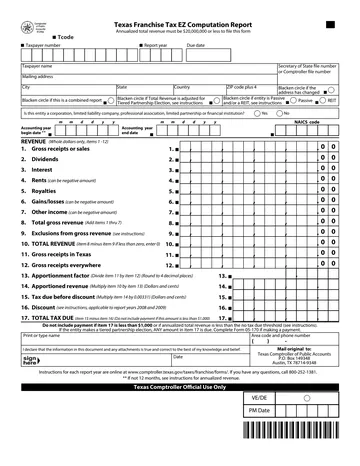
The Texas Franchise Tax EZ Computation Report, Form 05-169, is a one-page franchise tax report that taxes apportioned total revenue at 0.331% with no margin subtractions. The 2026 form is revision Rev.9-23/9, with the report year (2026) and due date (05/15/2026) printed on it. The line notes follow the 2026 Texas Franchise Tax Report Information and Instructions (Form 05-915), which mostly point back to the Long Form items.
- Who may use it. “Any entity (including a combined group) that has annualized total revenue of $20 million or less is eligible to use the EZ computation to report their franchise tax.” Below $2,650,000 annualized, no report is due at all.
- What you give up. “Taxable entities that elect this method to file are not eligible to take any credits or deductions.” “No margin deduction (COGS, compensation, 30% of revenue or $1 million) is allowed when choosing the EZ computation method.”
- When. May 15, 2026, with the same extensions as the Long Form (Nov. 16, 2026 for non-EFT payors with a timely request and payment).
- With it. The PIR or OIR; the Affiliate Schedule (05-166) for a combined group; the Tiered Partnership Report (05-175) for that election; and the Payment Form (05-170) when paying by check.
The form, with hotspots
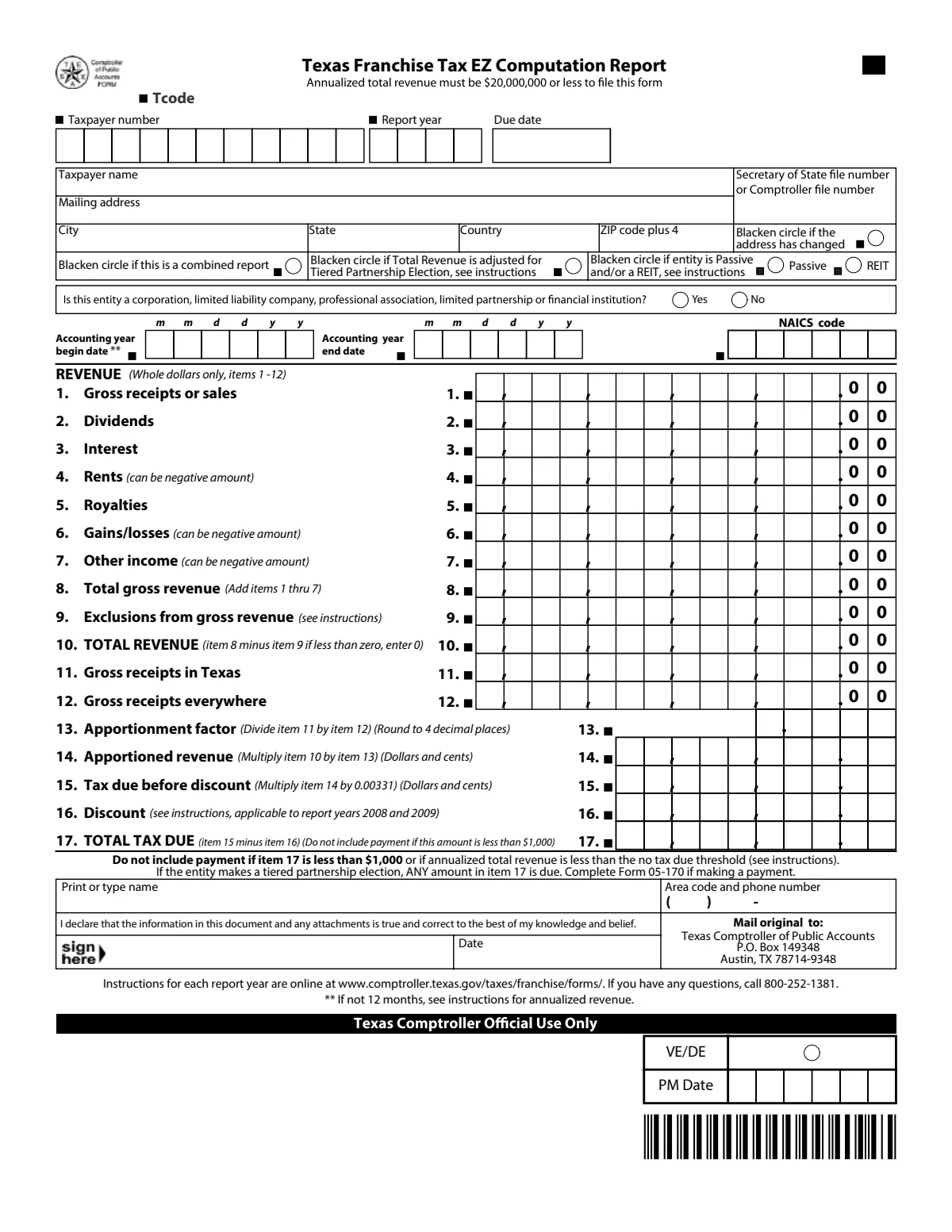
The 2026 E-Z report from the Comptroller's PDF. Hover or tap a box for the short rule; click it to jump to the full note. The official use area at the bottom has no hotspots.
Tap a box once for its note, again to jump to the line. Zoom in to read the small print.
Taxpayer information
The top block matches the Long Form's, without the SIC code. A qualifying passive entity or REIT completes this block only.
| Line | Label | What goes there |
|---|---|---|
| TPN | Taxpayer number | The 11-digit Texas taxpayer number the Comptroller assigned. If you do not have an assigned number, enter your federal employer identification number (FEIN). |
| Year | Report year; due date | 2026 and 05/15/2026 are printed on the 2026 form. The 2026 annual report is due May 15, 2026. |
| Name | Taxpayer name | The legal name of the entity filing the report. |
| SOS | Secretary of State file number or Comptroller file number | The number assigned to the entity by the SOS or Comptroller. |
| Address | Mailing address | The entity's mailing address. Notices from the Comptroller, including forfeiture notices, go here. |
| City | City, state, country, ZIP code plus 4 | The rest of the mailing address. |
| Addr-chg | Blacken circle if the address has changed | Blacken it for a new mailing address. Registered agent and registered office changes are filed with the Secretary of State, not on this form. |
| Combined | Blacken circle if this is a combined report | Combined groups are eligible for the EZ computation method. The test is the group's combined annualized total revenue. If a combined group elects to use the EZ computation method to report its franchise tax, the reporting entity is required to provide the requested information on Texas Franchise Tax Affiliate Schedule (Form 05-166) for each member of the combined group. |
| Tiered | Blacken circle if Total Revenue is adjusted for Tiered Partnership Election | Upper and lower tier entities making the election “qualify for the EZ computation only if the lower tier entity would have qualified for the EZ computation before total revenue is passed to the upper tier entities.” Both file the Tiered Partnership Report, Form 05-175. |
| Passive | Blacken circle if entity is Passive and/or a REIT | A qualifying passive entity or REIT files this report (or the Long Form) to affirm its status, blackens its circle and completes the taxpayer information only. |
| Entity-type | Is this entity a corporation, limited liability company, professional association, limited partnership or financial institution? | Yes: the entity files the Public Information Report. No: it files the Ownership Information Report. |
| Begin | Accounting year begin date | Enter the day after the end date on the previous franchise tax report. If the period is not 12 months, annualize revenue for the threshold and E-Z tests (see the rules below). |
| End | Accounting year end date | Enter the last accounting period end date for federal income tax purposes in the year before the year the report is originally due. |
| NAICS | NAICS code | The code for the entity's business, or the overall activity of a combined group. The E-Z form has no SIC code box because the E-Z rate does not depend on the industry. |
Items 1 to 10: total revenue
Total revenue is computed exactly as on the Long Form, from fixed lines of the federal return, in whole dollars. Items 1 to 12 are whole dollars; items 14 to 17 are dollars and cents.
| Line | Label | What goes there |
|---|---|---|
| 1 | Gross receipts or sales | See instructions for Item 1 on Form 05-158-A (page 15). In short: Form 1120, 1120S or 1065 line 1c, or Schedule C line 3. See the Long Form item 1 note. |
| 2 | Dividends | As Long Form item 2: Form 1120 line 4, Form 1120S Schedule K line 5a, Form 1065 Schedule K line 6a, Form 1041 line 2a. |
| 3 | Interest | As Long Form item 3. Zero or more; never negative. |
| 4 | Rents (can be negative) | As Long Form item 4. Net rental income from a K-1 goes on item 7, not here. |
| 5 | Royalties | As Long Form item 5. |
| 6 | Gains/losses (can be negative) | As Long Form item 6. |
| 7 | Other income (can be negative) | As Long Form item 7, including any total revenue passed to the entity by a lower tier entity under the tiered partnership election. |
| 8 | Total gross revenue | Items 1 through 7 added together. |
| 9 | Exclusions from gross revenue | “Do not enter COGS or compensation amounts as they cannot be deducted if electing to use the EZ computation.” The exclusions themselves are the same as Long Form item 9: bad debt, flow-through funds, net distributive income from other taxable entities, federal obligation interest and the industry exclusions. See the Long Form item 9 note. |
| 10 | Total revenue | Item 8 minus item 9; zero if less. At or below $2,650,000 annualized (with no tiered election), no report is due at all, only the PIR or OIR. Over $20 million annualized, this form is not available. |
Items 11 to 17: apportionment and tax
The E-Z apportions total revenue itself, not a margin, and multiplies it by one rate for every industry (Tex. Tax Code 171.1016).
| Line | Label | What goes there |
|---|---|---|
| 11 | Gross receipts in Texas | See instructions for Item 24 on Form 05-158-B (page 22) and Rule 3.591 for more information on determining Texas receipts. Goods delivered in Texas, services performed in Texas, Texas rentals and the other listed receipts. |
| 12 | Gross receipts everywhere | All business receipts for the same period, leaving out anything excluded from total revenue. See Long Form item 25. |
| 13 | Apportionment factor | Item 11 divided by item 12, rounded to 4 decimal places. Zero Texas receipts: enter 0 (no tax is due, but the report is filed). Item 11 equal to or more than item 12: enter 1.0000. |
| 14 | Apportioned revenue | Multiply Item 10 by Item 13. Dollars and cents. |
| 15 | Tax due before discount | “Multiply Item 14 by 0.331% (0.00331).” The rate is set by Tex. Tax Code 171.1016(b)(3). |
| 16 | Discount | Discounts do not apply to reports due after Dec. 31, 2009. |
| 17 | Total tax due | Item 17 must equal Item 15. “If this amount is less than $1,000, you owe no tax, but you must submit this report along with the Public Information Report (Form 05-102) and/or the Ownership Information Report (Form 05-167).” With a tiered partnership election, “ANY amount in item 17 is due”. |
Signature and mailing
| Line | Label | What goes there |
|---|---|---|
| Signer | Print or type name; area code and phone number | The name of the person who signs, and a phone number. |
| Sign | Signature and date | Report may be signed by an officer, director or other authorized person. This includes a paid preparer authorized to sign the report. |
| Mail original to | Texas Comptroller of Public Accounts, P.O. Box 149348, Austin, TX 78714-9348. Pay on Webfile or TEXNET, or by check payable to the Texas Comptroller with Form 05-170. |
E-Z or Long Form?
Between $2,650,000 and $20 million of annualized revenue you may file either report, and nothing stops you from computing both and filing the one with the lower tax. The E-Z rate of 0.331% applies to all apportioned revenue; the Long Form rate of 0.75% (or 0.375%) applies to apportioned margin, which is at most 70% of revenue.
Form 05-915 (2026): No Tax Due Threshold, EZ Computation and Minimum Franchise Tax; Tex. Tax Code 171.002(d) and 171.1016.
Our arithmetic, from the quoted rates: the Long Form at 0.75% produces less tax than the E-Z whenever the margin is under about 44.1% of total revenue (0.331 divided by 0.75). For a qualifying retailer or wholesaler at 0.375%, the 70% margin alone gives 0.2625% of apportioned revenue, which is always below the E-Z's 0.331%. A worked example, also ours:
| Our example | Amount |
|---|---|
| Total revenue (item 10) | $5,000,000 |
| Apportionment factor (item 13): $3,000,000 Texas receipts over $5,000,000 | 0.6000 |
| Apportioned revenue (item 14) | $3,000,000.00 |
| Tax (item 15): $3,000,000 times 0.00331 | $9,930.00 |
| Long Form at 0.75%, if margin is 70% of revenue: $3,500,000 x 0.6000 x 0.0075 | $15,750.00 |
| Long Form at 0.75%, if revenue less COGS leaves a $2,000,000 margin: $2,000,000 x 0.6000 x 0.0075 | $9,000.00 |
In the example the E-Z beats the 70% margin, but a business whose cost of goods sold leaves a margin of 40% of revenue pays less on the Long Form. The Texas franchise tax calculator runs both methods side by side.
Rules that trip filers up
- Annualize for eligibility. The $20 million and $2,650,000 tests use annualized revenue when the period is not 12 months; the tax uses the actual revenue. The Comptroller's example: $800,000 for 108 days annualizes to $2,703,703.70, so the entity “does NOT qualify for the $2,650,000 no tax due threshold, but is eligible to file using the EZ computation.”
- Credits are lost, not deferred. “When using the EZ computation, the current year’s portion of the temporary credit for business loss carryforwards may not be used and may not be carried over to a future period.”
- The $1,000 rule removes the payment, not the report. A tax under $1,000 is not due (Tex. Tax Code 171.002(d)), but the E-Z report and the PIR or OIR are still required.
- Tiered partnerships owe any amount. With the election, both tiers pay whatever item 17 shows, even under $1,000.
- Late filing. A $50 penalty applies to any late report, plus 5% of unpaid tax, and another 5% after 30 days; interest starts after 60 days.
How it connects
- The full report and every line it shares with this one: Form 05-158, Long Form.
- Rates, threshold and apportionment explained: Texas franchise tax; whether you file at all: Texas No Tax Due rules.
- The information report that goes with it: Form 05-102 or Form 05-167.
- Compare the two methods: the Texas franchise tax calculator. Other states' taxes: the franchise tax hub.
Questions filers ask
Who can file the Texas E-Z Computation Report?
Any taxable entity or combined group with annualized total revenue of $20 million or less. In a tiered partnership election, both tiers qualify only if the lower tier entity qualified before passing its revenue up.
What is the E-Z rate for 2026?
0.331% of apportioned total revenue (item 14 times 0.00331). The rate is in Tex. Tax Code 171.1016 and the 2026 instructions.
Can I take credits on the E-Z report?
No. An entity using the E-Z computation takes no credits or deductions for that report year, including the temporary credit for business loss carryforwards, and the current year's portion of that credit is lost.
My revenue is $1.9 million. Do I file the E-Z?
No. For 2026 the no tax due threshold is $2,650,000 of annualized revenue. At or below it, file only the Public Information Report or Ownership Information Report by May 15.
Can I switch between the E-Z and the Long Form each year?
The instructions treat the E-Z as an annual choice: an entity with $20 million or less may choose to file using it. Each year's report is computed on its own, so compare both methods every year.